How Component-Based Training Can Accelerate Service Technician Onboarding
Jul 24th 2026
Reading Time: 4 Minutes
Summary
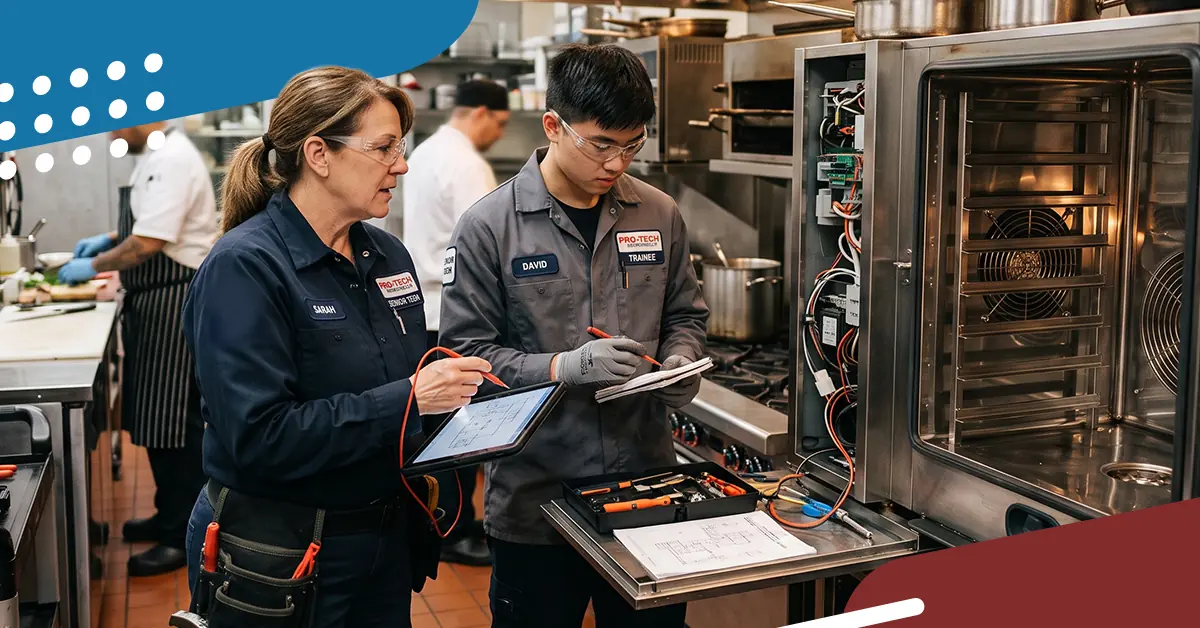
Developing entry-level ("green") technicians from adjacent trades is vital to combating the foodservice technician shortage. Rather than forcing new hires to memorize individual equipment platforms immediately, a component-based training model focuses on teaching how switches, relays, contactors, motors, and heating elements operate across multiple equipment categories. When combined with rigorous electrical safety training, lockout/tagout (LOTO) protocols, supervised field experience, and manufacturer documentation, this framework creates a safer, more structured path toward field readiness.
Why Technical Onboarding in Foodservice is Evolving
The commercial kitchen service industry competes directly with HVAC/R, electrical, automotive, and industrial maintenance trades for mechanically capable employees. At the same time, modern commercial kitchen hardware continues to incorporate highly advanced electronic controls, variable-speed components, and complex connectivity.
Because of these market conditions, service firms can't alway hire pre-certified, experienced food-equipment technicians. Instead, operations must frequently onboard entry-level technicians. Traditional training programs often struggle because they attempt to teach dozens of brand-specific wiring diagrams right away, overloading the trainee. A more effective approach establishes a firm foundation in universal electromechanical principles before introducing proprietary equipment platforms.
What Is Component-Based Training?
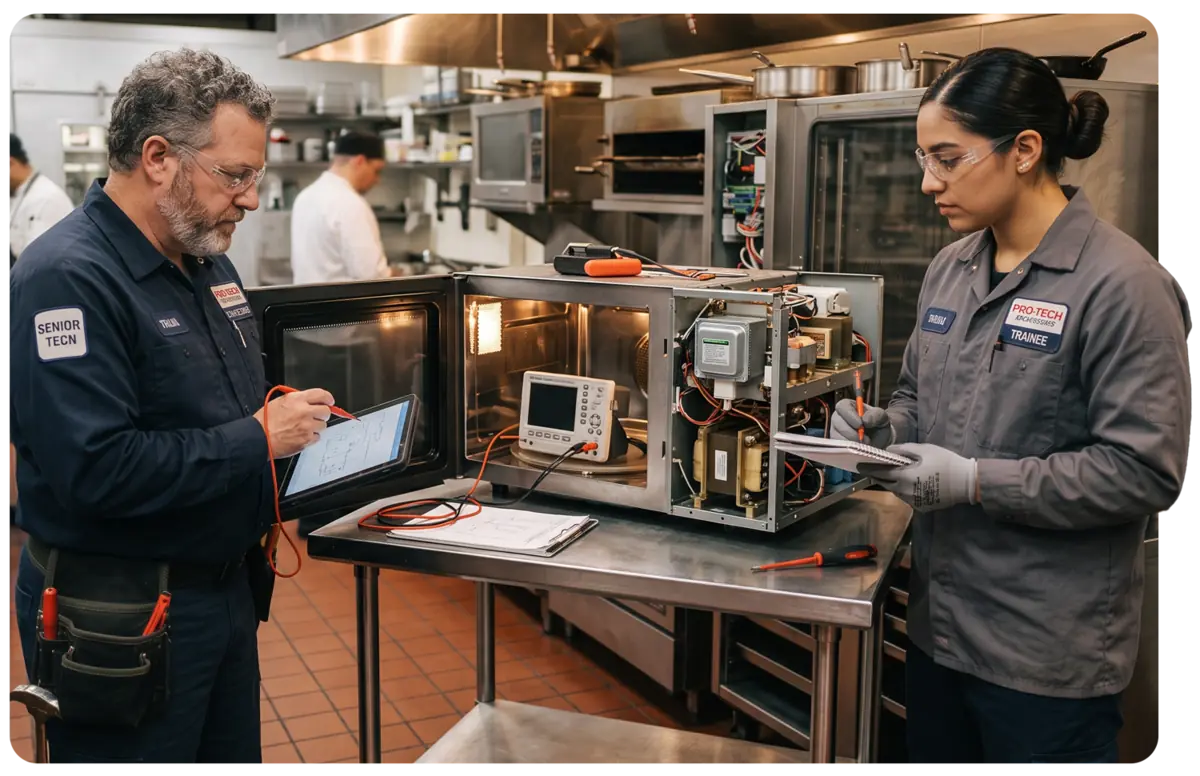
Component-based education focuses on teaching the core operating principles and testing procedures of recurring part families. A commercial kitchen utilizes many of the same foundational component types wrapped in different equipment configurations.
However, component-based training is not a license for loose parts substitution. While the basic functions of these components are similar across equipment categories, their exact technical specifications vary considerably. Technicians must be trained to recognize that components differ across crucial parameters:
- Voltage, frequency, and phase alignment
- Current (amperage) and horsepower (HP) ratings
- Pole and contact configurations (e.g., SPST vs. DPDT)
- Coil voltage requirements in control circuits
- Environmental, temperature, and safety certifications (such as NSF or UL)
Learning to identify these underlying parameters allows a technician to build strong pattern recognition, making them a more accurate diagnostician when they transition to specialized manufacturer training.
Core Component Families to Teach First
A structured foundational curriculum isolates the common denominators of foodservice equipment. Onboarding programs should focus deeply on these three primary segments:
1. Control Switches and Interlocks
Every circuit requires a mechanism to control data or power flow. Technicians must learn how to trace basic circuits using schematics and check for continuity across toggle switches on countertop griddles, door micro-switches on convection ovens, and magnetic interlocks on commercial microwaves. This ensures the circuit is fully de-energized before testing continuity.
2. Contactors and Power Relays
Contactors allow a lower-power control circuit to safely switch a higher-current load, such as heating elements in commercial fryers or booster heaters. Training should focus on evaluating coil voltage, line and load conditions, and contact pitting. Technicians must learn to follow the wiring diagram to verify the underlying cause of a failure rather than assuming a faulty contactor is the root issue.
3. Motors and Air Movement
From fan motors to pump assemblies, understanding rotating machinery is critical. Under qualified supervision, entry-level technicians can learn to read motor nameplates, compare measured current with rated values using a clamp meter, and test capacitors using appropriately rated test equipment. Trainees must be taught that capacitors retain hazardous stored energy after disconnection and must be isolated, verified, and discharged according to approved safety procedures.
Example 30-Day Foundational Training Plan
This framework serves as an example for foundational onboarding and pattern recognition; it is not a guarantee of independent field readiness. Technicians should advance to independent tasks only after demonstrating complete competency under the company’s safety, supervision, certification, and quality-control requirements.
| Training Phase | Competency Focus | Suggested Competency Check |
|---|---|---|
| Days 1–10 | Safety, Documentation & Meter Fundamentals | Demonstrates exact lockout/tagout procedures, identifies energy sources, selects properly rated test equipment, and performs de-energized measurements under supervision. |
| Days 11–20 | Component Function & Supervised Diagnostics | Correctly identifies common switches, relays, contactors, motors, and heating components in a lab environment; successfully traces basic circuits using equipment diagrams. |
| Days 21–30 | Parts Identification & Supervised Service Tasks | Records complete equipment and component data (model/serial numbers), researches approved cross-reference materials, and completes defined repairs under direct review. |
Sourcing and Component Verification Fundamentals
A key benefit of component-based training is teaching technicians how to gather comprehensive parts data. When an equipment failure is identified, a technician must be trained to document the equipment model, serial number, and all complete markings stamped onto the failed component.
When dealing with out-of-warranty equipment, this thorough data gathering allows procurement teams to consult approved cross-reference resources. If an approved alternative from an Original Component Manufacturer (OCM) is available, it can be utilized safely.
Safety Note: Qualification and Authorization Boundary
Electrical testing and component replacement should be performed only by technicians who have received the required safety training and are authorized by their employer. Always follow your company’s lockout/tagout (LOTO) procedures, verify the absolute absence of voltage with properly rated test equipment, utilize appropriate Personal Protective Equipment (PPE), and consult the original equipment manufacturer’s service instructions. Energized testing must be strictly limited to qualified personnel and performed exclusively under approved safe-work procedures.
Frequently Asked Questions (FAQs)
Can standardized components support hands-on technician training?
Yes. De-energized training boards and controlled laboratory exercises are highly effective tools for helping entry-level technicians learn to wire, test, and diagnose common switches, relays, contactors, and motors. Training components should be selected specifically for the exercise by a qualified instructor and should never be treated as automatically interchangeable with parts used in live, operating kitchen equipment.
Which equipment track is best for an entry-level technician's progression?
There is no single correct starting path for every service company. Many programs begin with preventative maintenance, equipment identification, and lower-complexity electromechanical repairs under direct supervision. Hot-side equipment provides excellent exposure to basic control loops but involves hazardous voltages, gas combustion, and steam. Cold-side training can begin with airflow and temperature-control fundamentals, but any work that could reasonably release regulated refrigerants must be strictly reserved for technicians holding the appropriate EPA Section 608 certification.
How does component knowledge affect first-time fix rates?
Component-based training improves first-time fix performance by helping technicians isolate the actual mechanical or electrical failure rather than blindly swapping parts based only on visual symptoms. It teaches them to capture the exact technical specifications needed for accurate parts identification. When an OCM is verified and available in warehouse or truck stock, that knowledge helps the technician complete the repair accurately and safely without unnecessary shipping delays.