Understanding NSF Standards in Back-of-House Parts Sourcing
Aug 26th 2026
Reading Time: 4 Minutes
Summary
Replacing commercial kitchen components without verifying their materials, intended use, and applicable sanitation listings can create inspection and performance risks. NSF/ANSI standards establish sanitation criteria for commercial food equipment, including material safety, cleanability, corrosion resistance, and performance. The specific rules that apply depend on the equipment category, component application, and regulations adopted by the local authority having jurisdiction.
Procurement managers and parts buyers can reduce compliance risk by identifying the applicable equipment standard, determining the component’s use zone, reviewing the exact certification or listing scope, and cross-referencing OEM and OCM replacement options against published specifications.
Why Sanitation Standards Matter in Parts Procurement
In commercial foodservice operations, replacement parts fulfill a specific electromechanical function. But that's not all they do. They're also required to meet applicable sanitation regulations and equipment requirements.
State and local health codes may incorporate or recognize sanitation standards such as those developed by NSF and approved as American National Standards through ANSI’s standards process. Installing an unverified component, such as a noncompliant door gasket, storage rack, or fluid-transfer tube, may place the equipment outside its originally evaluated configuration, create sanitation or performance problems, and raise questions during an inspection.
The effect on a certification or listing depends on the component, the equipment listing, the certification body’s requirements, and the local authority having jurisdiction. Understanding how NSF/ANSI standards and accredited certification programs apply to commercial food equipment helps buyers make better sourcing decisions while reducing compliance risk.
Frequently Encountered NSF/ANSI Equipment Standards
NSF/ANSI standards establish criteria for material safety, cleanability, construction, durability, and performance. While many specialized standards apply across commercial foodservice, four frequently encountered examples include:
NSF/ANSI 2: Food Equipment
Establishes minimum sanitation requirements for the materials, design, fabrication, construction, and performance of commercial food-handling and processing equipment, such as preparation tables, sinks, storage shelving, counters, and related components.
NSF/ANSI 3: Commercial Warewashing Equipment
Establishes sanitation requirements for the materials, design, construction, and performance of commercial dishwashing, glasswashing, and pot, pan, and utensil-washing machines and their related components.
Commercial booster heaters are addressed by NSF/ANSI 5, while detergent and chemical feeders for commercial spray-type dishmachines are addressed by NSF/ANSI 29.
NSF/ANSI 7: Commercial Refrigerators and Freezers
Establishes food-protection and sanitation requirements for commercial refrigerators, freezers, and related components. Covered equipment includes reach-ins, undercounter units, walk-ins, roll-ins, refrigerated preparation units, display refrigerators, beverage coolers, and other commercial cold-holding equipment.
NSF/ANSI 51: Food Equipment Materials
Establishes public-health requirements for materials and finishes used in commercial food equipment and components, including tubing, sealants, gaskets, and valves. Listings may include limitations related to temperature, food type, color, or intended use.
A material listing alone does not establish that the finished component or complete equipment assembly is certified for every application.
Other major standards include NSF/ANSI 4 for commercial cooking and hot-food holding equipment, NSF/ANSI 8 for powered food-preparation equipment, and NSF/ANSI 12 for automatic ice-making equipment.
Navigating Kitchen Equipment Food Zones
Commercial food-equipment sanitation standards commonly classify surfaces according to how they interact with food and food soil. A component’s classification depends on the equipment design, exposure, and scope of the applicable standard or certification listing.
The examples below are illustrative and should not replace the equipment documentation or certification listing.
| Equipment Zone | Definition | Typical Examples | General Material and Design Considerations |
|---|---|---|---|
| Food Zone | Surfaces that contact food directly or from which food may drain, drip, or splash back into the product. | Slicing blades, augers, food pans, mixing bowls, product-contact tubing, and dispensing nozzles. | Smooth, cleanable, durable, corrosion-resistant, and nontoxic materials suitable for the intended food, temperature, and cleaning conditions. Joints, seams, fasteners, and internal geometry must meet applicable cleanability requirements. |
| Splash Zone | Surfaces subject to spattering, spillage, or food soil during normal operation, but from which food does not return to the product. | Backsplashes, splash guards, non-product-return drip trays, and control panels or hinges exposed to splash. | Smooth, nonabsorbent, cleanable, and corrosion-resistant materials suitable for expected exposure to food soil, moisture, grease, and cleaning chemicals. |
| Nonfood Zone | External or internal structural surfaces that do not contact food and are not exposed to splash during normal operation. Certification literature may also use the term “Non-Food Zone.” | Frame assemblies, enclosed motor housings, protected compressor-compartment panels, and other non-product-contact structural components. | Durable and cleanable construction without unnecessary ledges, crevices, or inaccessible areas that can accumulate soil or provide pest harborage. |
Sourcing Rule: Replacement parts used in a Food Zone must meet the material, design, cleanability, and use limitations applicable to that specific equipment and application. Do not substitute a general-purpose industrial component in a food-contact application without documentation supporting its intended use.
Five Checks Before Ordering a Replacement Part
When sourcing replacement hardware, gaskets, tubing, or mechanical components, procurement teams should follow this verification process:
1. Identify the Machine Model and Serial Number
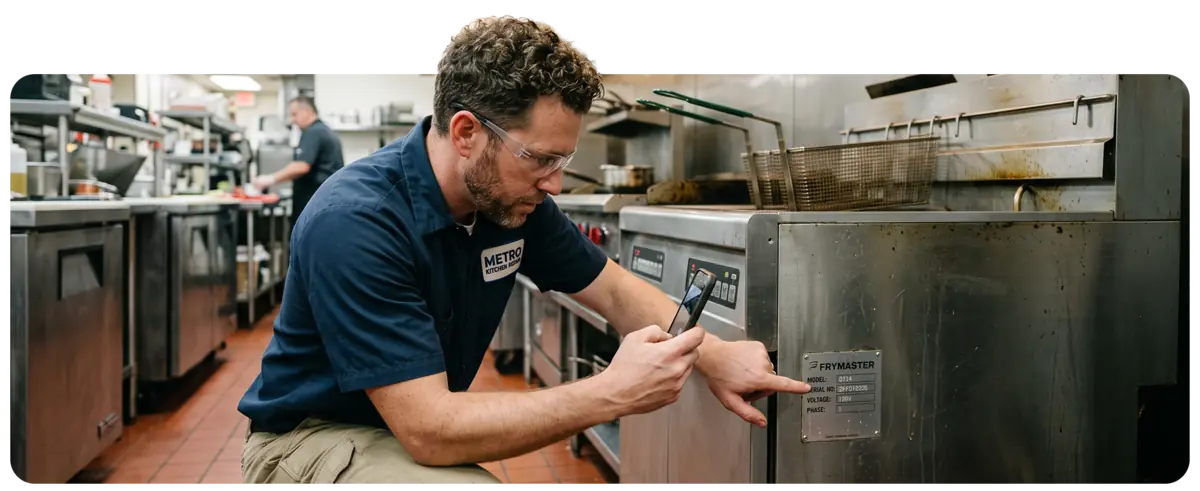
Certification listings identify specific equipment models, configurations, and manufacturing conditions. Always begin by checking the unit’s data plate and recording the complete model and serial number.
2. Determine the Application and Use Zone
Consult the equipment documentation, original component specifications, and applicable certification listing to determine whether the part is used in a Food, Splash, or Nonfood Zone.
3. Review Component Material Specifications
Confirm that elastomers, plastics, metals, coatings, and adhesives are suitable for the expected temperature, food type, chemical exposure, and cleaning process.
When FDA food-contact requirements apply, obtain documentation identifying the relevant regulatory basis rather than relying on a generic “food-grade” claim.
4. Verify the Exact Listing
Search the certification body’s official directory for the exact manufacturer, model, trade name, material, or component. Review all listing notes, use-zone restrictions, temperature limits, and manufacturing-location requirements.
Sanitation certification does not automatically establish electrical, fire, pressure, or plumbing compliance. Confirm any additional certifications or listings required for the component and application.
5. Inspect and Document the Delivered Part
Confirm the part number, manufacturer, markings, material documentation, and certification information against the purchase record. Inspect food-exposed surfaces for damage, pits, rough edges, open seams, or other conditions that could interfere with cleaning.
Evaluating OCM Alternatives for Eligible Applications
An OEM-branded replacement may not be the only acceptable option in every application. Some Original Component Manufacturer (OCM) components may provide a suitable alternative when their materials, specifications, intended use, and applicable certification scope are verified for the equipment.
Through AllPoints, OCM replacement parts can provide a cost-effective alternative for eligible applications. AllPoints OCM parts cost approximately 15% less on average than their OEM-branded counterparts.
Certification and use limitations vary by component, so buyers should verify the exact part against the equipment model, serial number, operating conditions, original specifications, and applicable sanitation listing before installation.
Frequently Asked Questions
Does replacing an OEM part with an OCM part void the equipment’s NSF certification?
Not automatically, but buyers should not assume that material and dimensional similarity alone preserve the equipment’s certification status.
The effect depends on the original equipment listing, the function and use zone of the component, the replacement part’s certification or documentation, and the requirements of the certification body and local authority. Verify the equipment manufacturer’s instructions, the exact listing scope, and any applicable regulatory requirements before substituting a component.
How can a buyer verify that flexible hose or tubing is documented for food contact?
Food-contact tubing should include documentation identifying the manufacturer, exact product or formulation, intended application, temperature and chemical limitations, and applicable certification or regulatory basis.
NSF/ANSI 51 applies to food-equipment materials, while NSF/ANSI/CAN 61 applies specifically to components used in drinking-water systems. Confirm the exact product in the certification body’s official directory and review all listing limitations.
Do not rely solely on a generic “food-grade” label or use unrated industrial tubing for food, beverage, or potable-water service.
What is the difference between NSF Certified and NSF compliant?
“NSF Certified” means NSF has independently evaluated the identified product or material and included it within an active NSF certification listing. A product may also be certified to an NSF/ANSI standard by another accredited certification body, in which case the certifier and applicable standard should be identified.
“NSF compliant” is not an independent certification. It is often a manufacturer or supplier claim that a product meets specified requirements, and the basis for that claim may vary. Buyers should review supporting documentation and verify whether the application requires accredited third-party certification.
Streamline Compliant Parts Sourcing
Maintaining sanitation compliance across a fleet of commercial kitchen equipment requires accurate component matching and reliable sourcing.
Use the AllPoints Parts Catalog and Technical Resources to identify compatible hardware, gaskets, fittings, and replacement components. Confirm all required sanitation certifications, listing limitations, and equipment specifications before installation.