NSF vs UL Certification: What's the Difference for Foodservice Equipment?
Jan 29th 2026
Reading Time: 5 Minutes
As a business owner, you aren't just selling repairs; you are selling risk management.
When your technician walks out of a commercial kitchen, that equipment needs to be safe and compliant. If a fryer catches fire or a health inspector flags a dishwasher for poor sanitation, the first question asked is often, "Who worked on this last?"
You see the NSF and UL badges on every piece of equipment, but do your technicians understand the distinction? More importantly, do you understand how techs can void those certifications and open your company up to liability?
Here is the executive breakdown of the two most critical acronyms in the industry, and why your purchasing strategy needs to align with them.
 1. NSF (National Sanitation Foundation)
The Focus: Sanitation & Food Safety.
"Is this easy to clean and safe for food?"
When you see the blue NSF circle, it means the equipment’s design prevents bacteria growth.
- Design Standards: It ensures there are no jagged welds where food can get trapped, no toxic materials in the food zone, and that the unit can hold safe temperatures (e.g., a refrigerator holding below 41°F).
- Why It Matters for Repairs: If your tech replaces a stainless steel shelf with a galvanized one that rusts, or uses a generic gasket that doesn't seal properly, the unit is no longer "NSF Compliant." If a health inspector notices, they can red-tag the equipment.
 2. UL (Underwriters Laboratories)
The Focus: Electrical & Fire Safety.
"Will this shock someone or burn the building down?"
UL is an OSHA-approved testing lab. They torture-test equipment to ensure wiring doesn't overheat, motors don't spark, and gas valves close when they’re supposed to.
- The "Classified" Note: You might see "UL Classified" on certain components (such as a hood filter). This means that specific part has been tested.
- Why It Matters for Repairs: This is the big one for liability. If a technician installs a generic, non-UL switch that isn't rated for the amperage of the oven, and that switch melts and causes a fire, your company is on the hook. Insurance adjusters look for these things.
3. The "Equivalent" Confusion (ETL and CSA)
Your techs will also see ETL (Intertek) and CSA stickers.
For all practical and legal purposes in the US and Canada, ETL is equivalent to UL, and CSA is often equivalent (depending on the specific standard cited).
Don't let a customer panic when their new oven has an ETL sticker instead of a UL sticker. Both are Nationally Recognized Testing Laboratories (NRTLs).

How You Lose Certification
Here is the operational risk for your business: The original certification of a machine is based on the components inside it.
If a fryer was UL-listed with a specific Robertshaw gas valve, and your technician installs a cheap, unbranded "universal" valve to save $20, that machine is technically no longer the machine that was tested. You have altered the safety profile.
This creates a conflict for owners:
- Buy OEM: Keep the certification safe, but suffer from high costs and long lead times.
- Buy Generic Aftermarket: Save money, but risk liability and quality issues.
The Solution: OCM Parts
This is why the industry shift toward OCM (Original Component Manufacturer) parts is critical for your bottom line.
Since OCM parts are sourced from the same manufacturing lines as the OEM parts (e.g., the exact same compressor or motor, just not in the branded box), they maintain the original unit's performance and safety standards.
- Risk Mitigation: You aren't guessing if the voltage tolerance matches. It is the original part.
- Profitability: You get the lower price point of the aftermarket, allowing you to be competitive on bids without exposing your company to "improper repair" liability.
Summary for Your Team
Make sure your technicians know the rule:
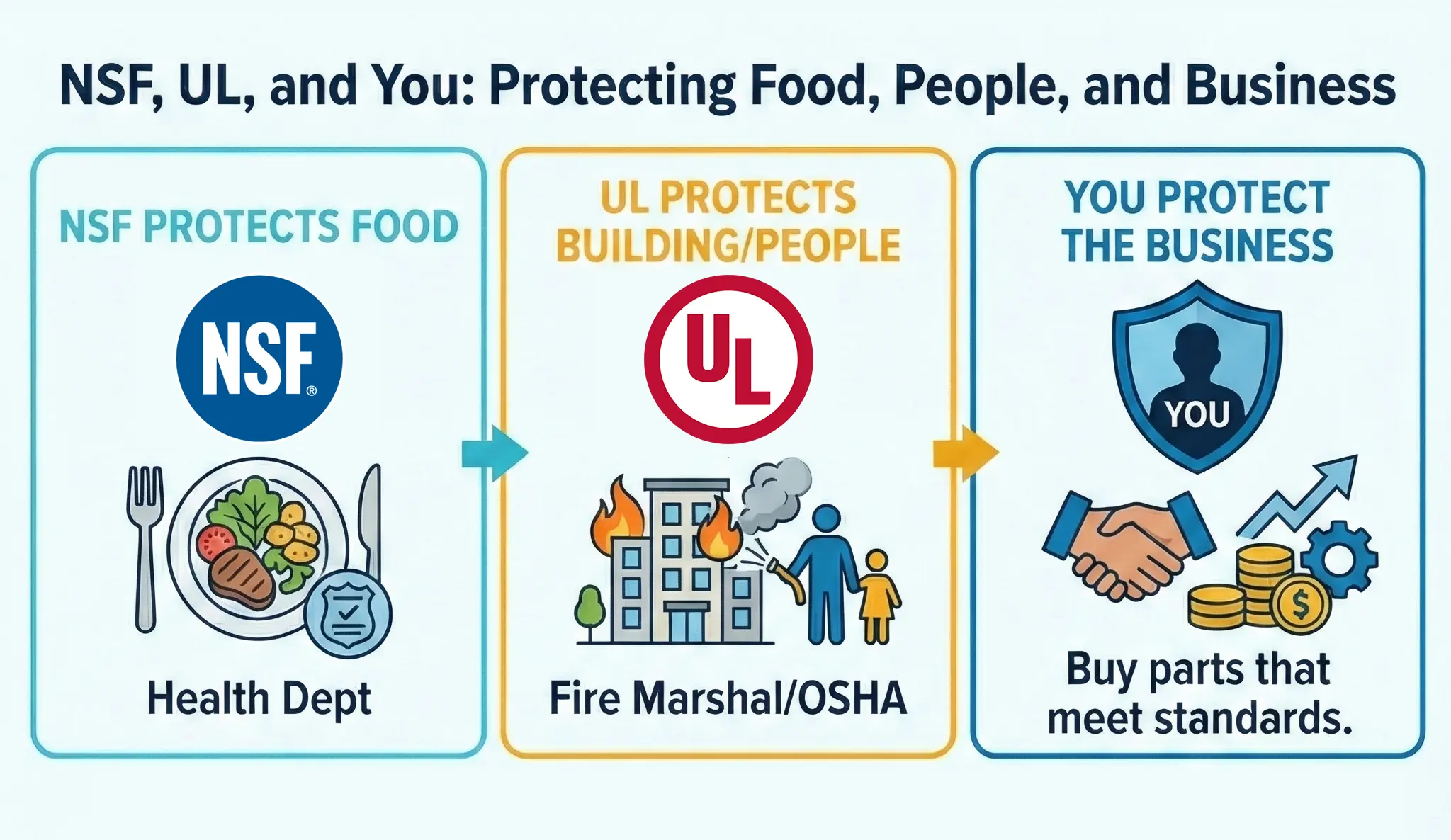
- NSF protects the Food (Health Dept).
- UL protects the Building/People (Fire Marshal/OSHA).
- You protect the Business by buying parts that meet those standards.
Keep your repairs compliant and your margins healthy.
Source rigorous, OCM-quality components for every major brand at AllPointsFPS.com.