How to Troubleshoot a Commercial Griddle That Won't Heat Evenly
Jan 30th 2026
Reading Time: 8 Minutes
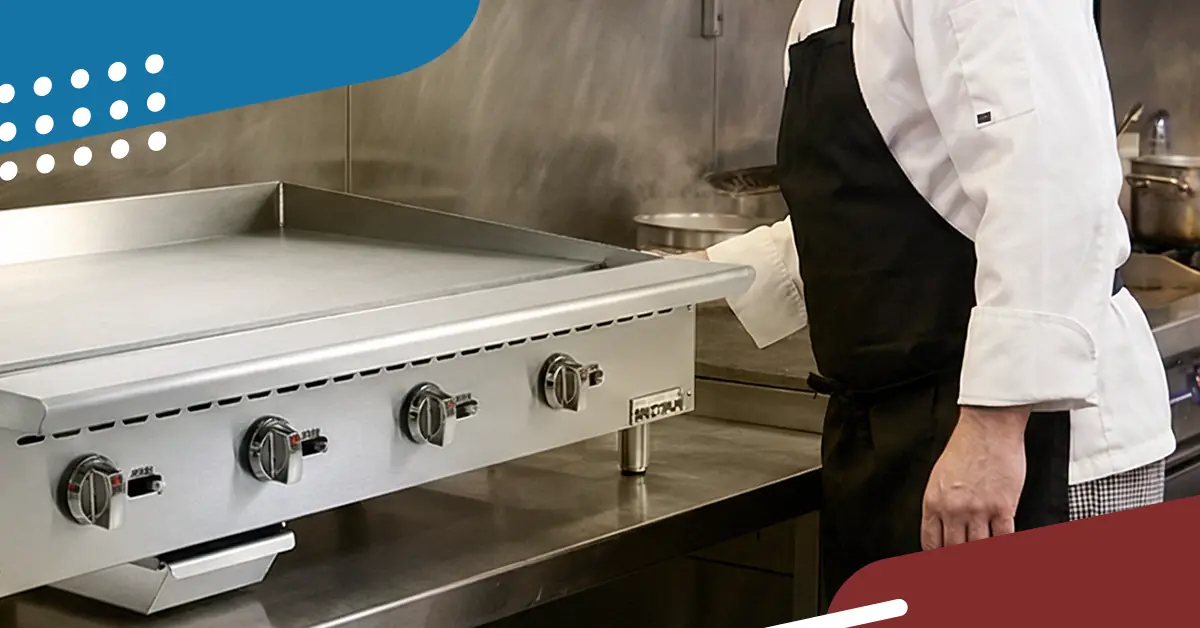
There are few things a line cook hates more than a griddle with "cold spots."
It kills their rhythm. They throw a row of burgers down, and the patties on the left sear perfectly, but the patties on the right sit gray and lifeless. The result? Extended ticket times, inconsistent food quality, and a service call.
"Uneven heating" is a vague complaint that covers a spectrum of mechanical sins. Most often, it's an issue of airflow, calibration, or a component failure. Here is your step-by-step guide to diagnosing the zones and getting that flat top back to uniform temperature.
The "Non-Mechanical" Checks
Before you start tearing off the front panel, rule out environmental factors. These are often the culprits when the equipment is actually working fine, but the conditions are wrong.
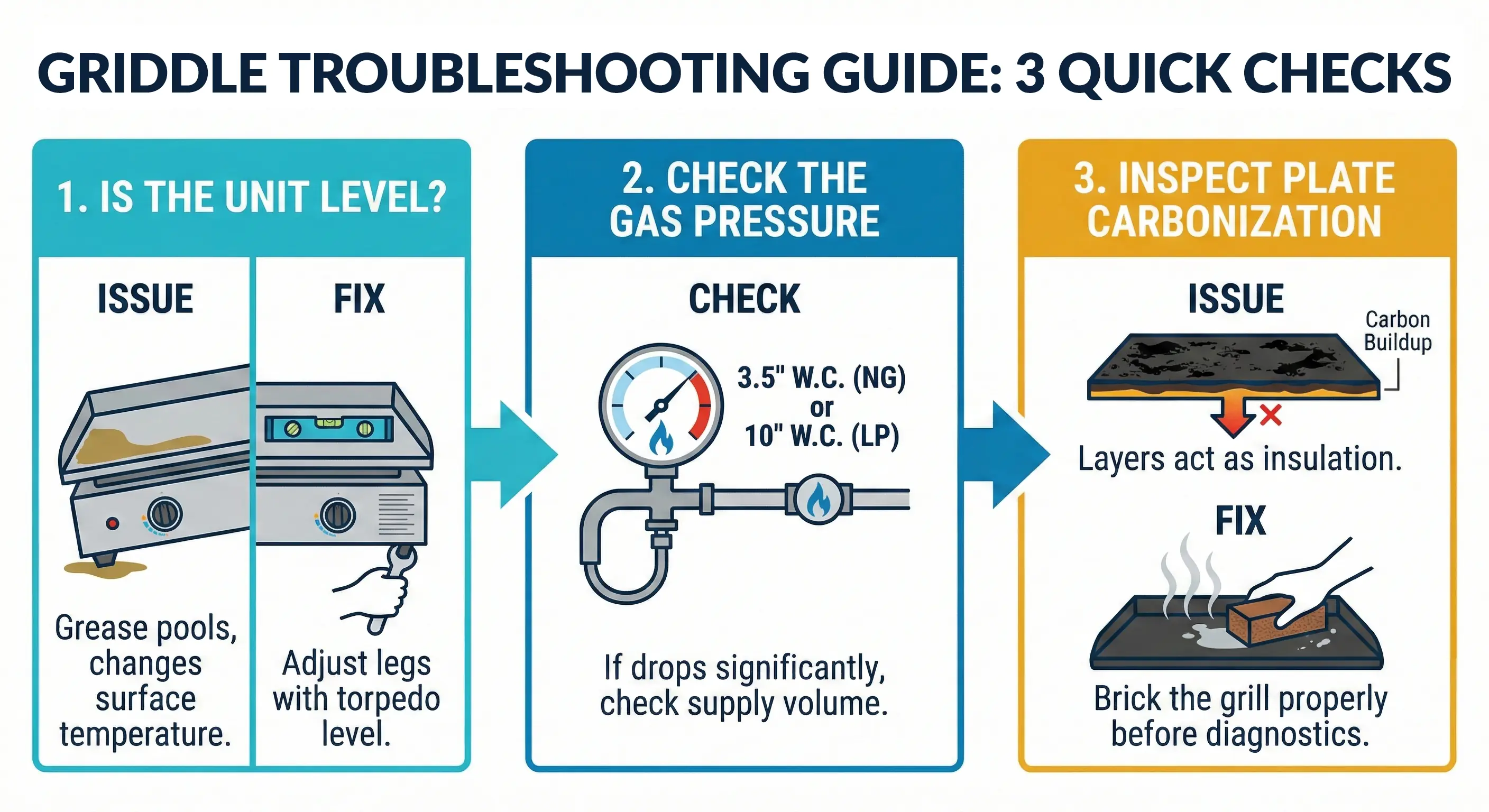
1. Is the Unit Level?
This sounds basic, but it’s the #1 cause of uneven cooking.
- Issue: If the griddle leans to the left, the grease pools on the left. The pooling grease acts as a heat sink (or sometimes an insulator), changing the surface temperature.
- Fix: Put a torpedo level on the plate (front-to-back and side-to-side). Adjust the legs.
2. Check the Gas Pressure
If the entire unit feels sluggish or has a weak recovery time, the manifold pressure might be too low.
- Check: Hook up your manometer. You should be seeing the manufacturer’s spec (typically 3.5" W.C. for Natural Gas, 10" W.C. for LP). If it drops significantly when all burners fire, you have a supply volume issue, not a parts issue.
3. Inspect Plate Carbonization
Is the plate black and crusty? Layers of carbon buildup act as insulation. The thermostat (located under the plate) might be reading the steel temperature correctly, but the carbon layer prevents that heat from reaching the food.
- Fix: Tell the customer to brick the grill properly before you proceed with diagnostics.
Troubleshooting Gas Griddles
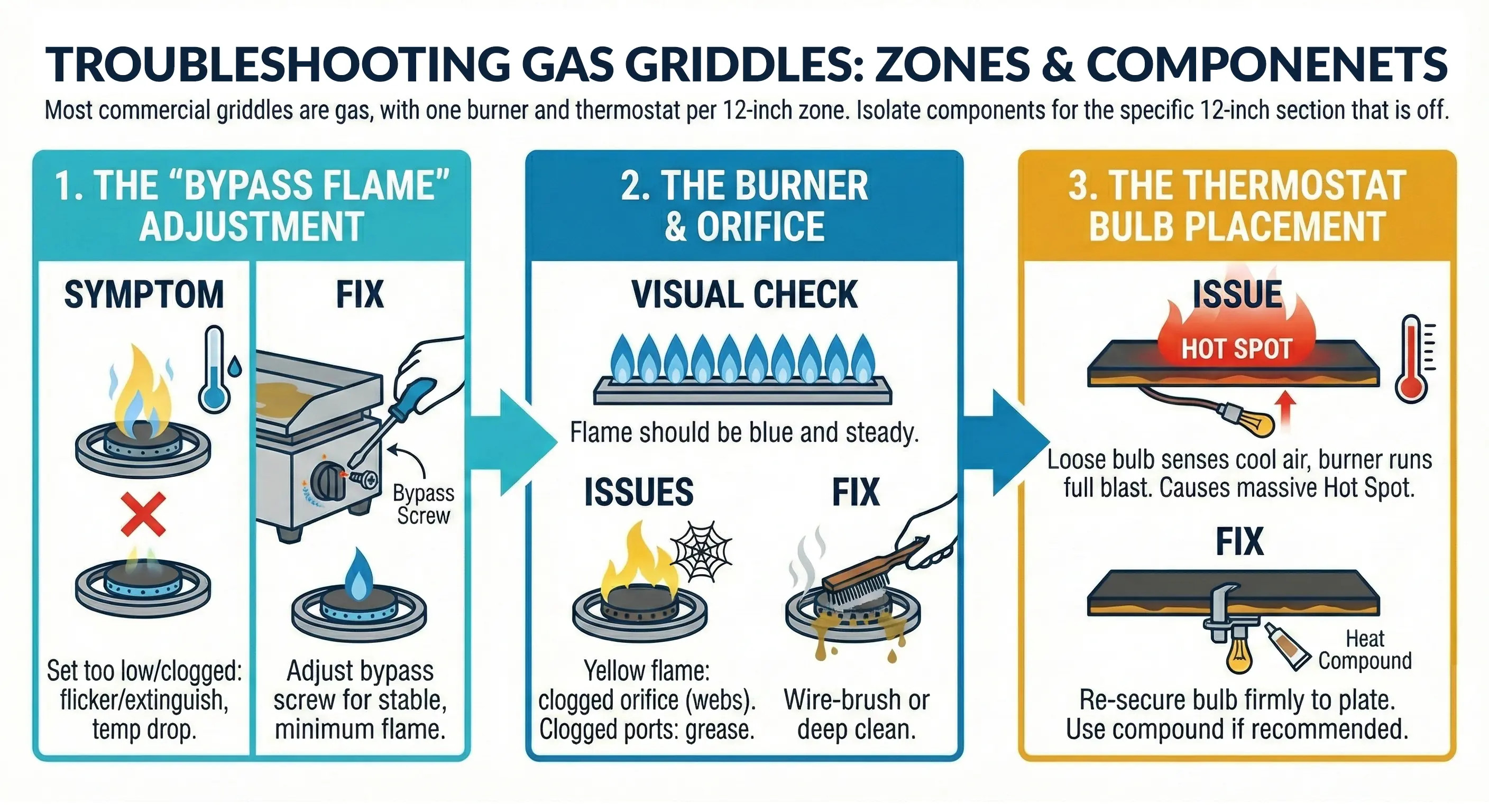
Most commercial griddles are gas. They rely on "zones," usually one burner and thermostat every 12 inches. If one zone is off, you need to isolate the components for that specific 12-inch section.
1. The "Bypass Flame" Adjustment
This is the most common "gotcha" for younger techs. Gas thermostats have two flame settings:
- Full Flame: When the thermostat calls for heat.
- Bypass (Low) Flame: A minimum flame that stays on even when temp is reached, to prevent the burner from blowing out and to ensure rapid re-ignition.
- Symptom: If the bypass flame is set too low (or clogged), the burner might flicker or extinguish completely when the thermostat satisfies. When it calls for heat again, it might not light immediately, causing a temperature drop in that zone.
- Fix: Locate the bypass screw on the thermostat body. With the knob turned to "Off" (but the pilot lit) or the lowest setting, adjust the screw until you have a stable, minimum flame across the entire burner.
2. The Burner & Orifice
- Visual Check: Pull the plate or look through the sight glass. Is the flame blue and steady?
- Yellow/Lazy Flame: Indicates poor air mixture or a clogged orifice (spider webs are common here). A lazy flame doesn't generate the BTUs needed for recovery.
- Clogged Ports: Grease often drips down and clogs the burner ports. Wire-brush the burner or remove it for a deep clean.
3. The Thermostat Bulb Placement
The thermostat senses heat via a bulb clamped to the underside of the griddle plate.
- Issue: If the bulb clamp has come loose, the bulb might be hanging in the air rather than touching the plate. It will sense the cooler air temperature and keep the burner running full blast, creating a massive Hot Spot that burns everything.
- Fix: Re-secure the bulb firmly against the plate. Use a heat-conductive compound if the manufacturer recommends it.
Troubleshooting Electric Griddles
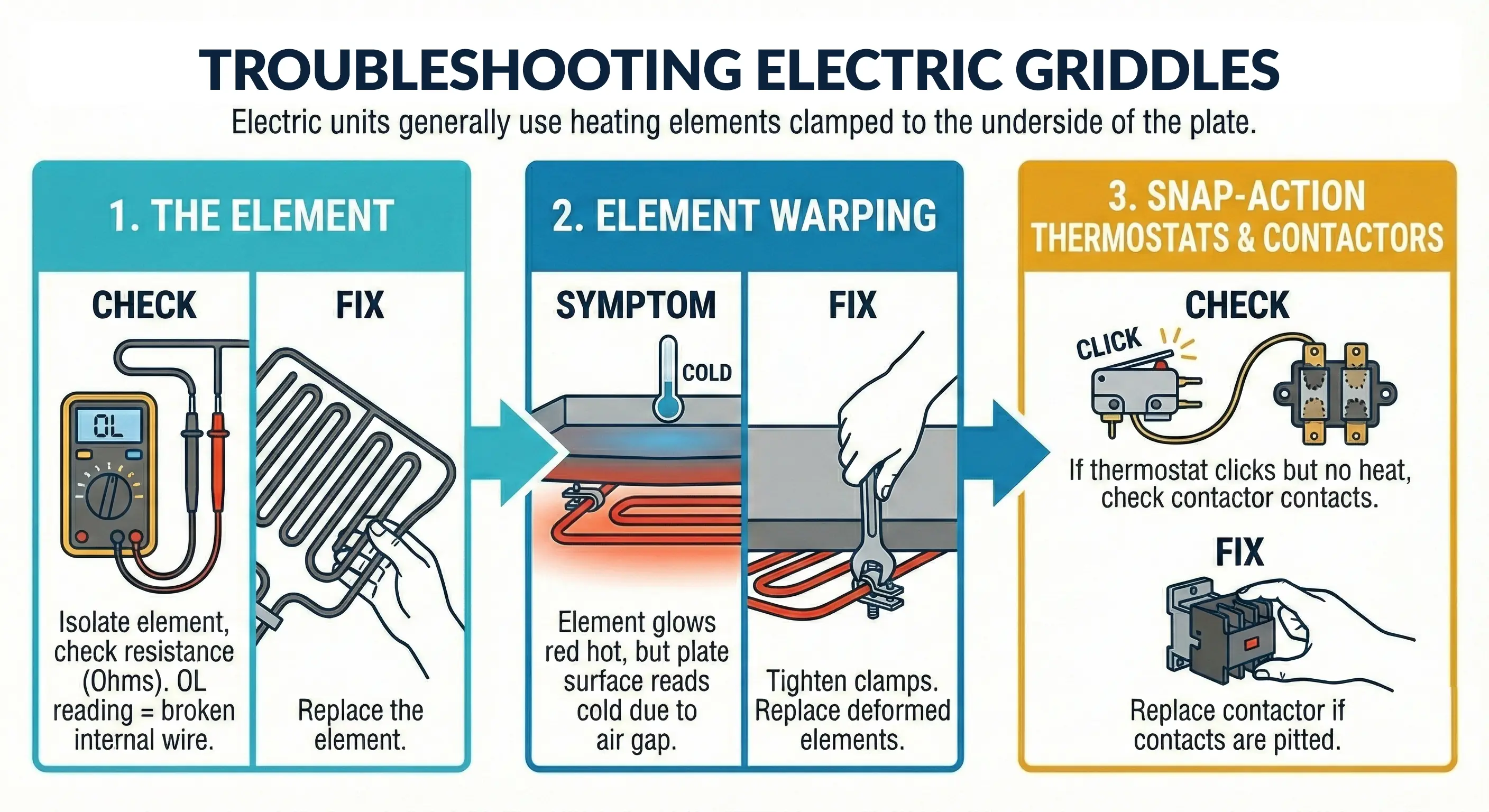
Electric units generally use heating elements clamped to the underside of the plate.
1. The Element
Electric griddles usually have multiple elements per zone to ensure coverage. If one element in a pair burns out, that zone will be weak.
- Check: Isolate the element and check for resistance (Ohms). An "OL" (Open Loop) reading means the internal wire is broken. Replace the element.
2. Element Warping
- Issue: Elements must be clamped tight to the plate for conductive heat transfer. Over time, clamps loosen or elements warp, creating an air gap.
- Symptom: The element glows red hot (because it can't shed its heat into the plate), but the plate surface reads cold.
- Fix: Tighten the clamps. If the element is deformed, it must be replaced.
3. Snap-Action Thermostats & Contactors
Many electric griddles use a snap-action thermostat that triggers a magnetic contactor.
- Check: If the thermostat clicks but the element doesn't heat, check the contactor. Pitted contacts often fail to conduct voltage even when pulled in.
Proper Calibration (The Final Step)
Never leave the site without calibrating.
- Clean the surface (no carbon buildup).
- Set all dials to 350°F.
- Allow the unit to cycle 3 times (heat up, satisfied, heat up).
- Use a Surface Probe (not an infrared gun — IR guns reflect off shiny metal and give false readings).
- Place the probe directly over the thermostat sensing bulb for that zone.
- Most mechanical stats allow a variance of +/- 15°F to 25°F.
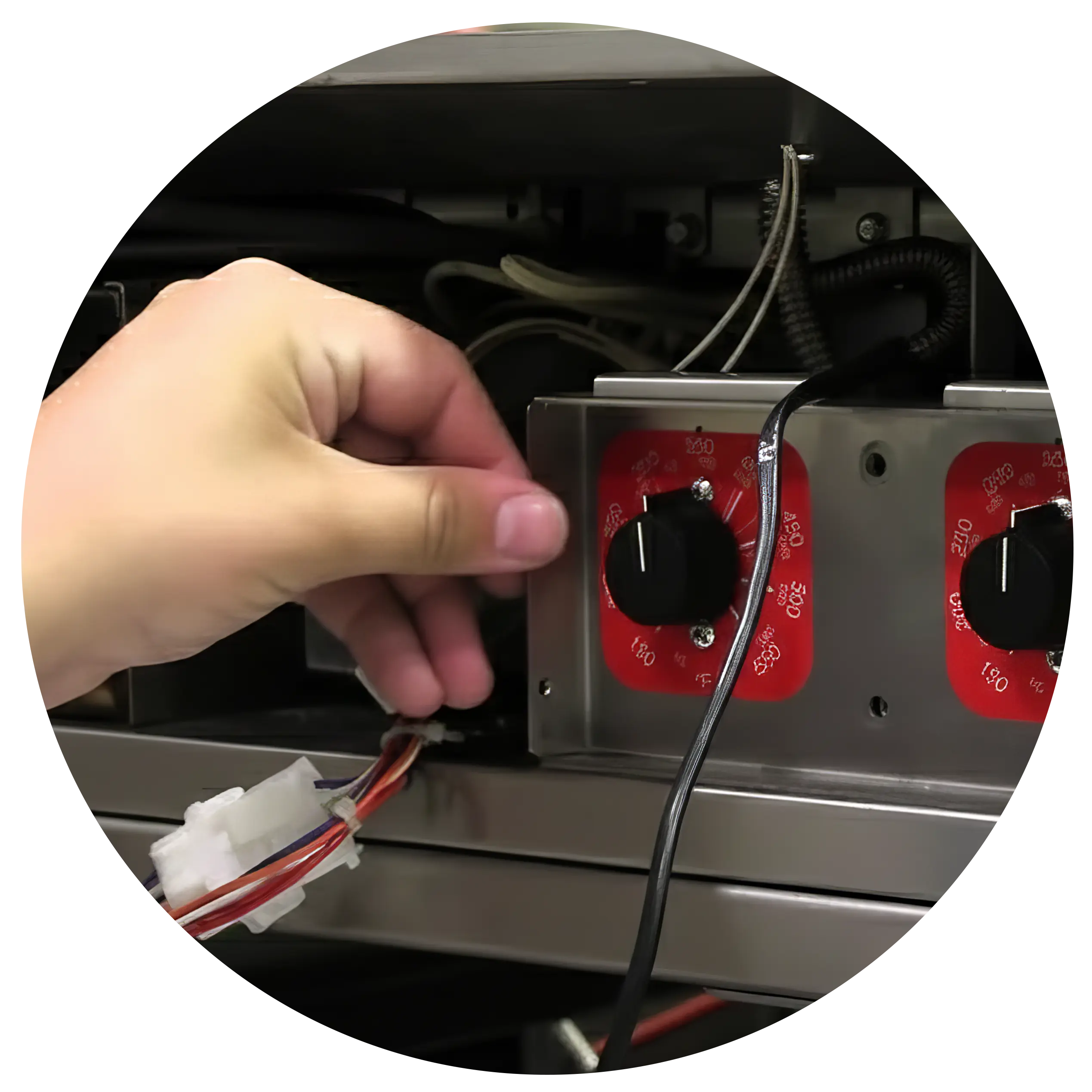
- Adjust: Pull the knob. Use a flathead screwdriver to turn the stem down and adjust the set screw. Clockwise usually decreases temperature, and counter-clockwise increases.
The "First-Time Fix" Strategy
When you identify a bad thermostat or a cracked burner, you need a replacement fast.
- Thermostats are high-wear items. AllPoints stocks thermostats for major brands like Vulcan, Star, and Imperial.
- Stock the Truck: Since griddle issues are often gas-related, keep a universal pilot kit and a manometer on the truck at all times.
Need a replacement burner or thermostat?
Don't wait on backorders. Search our inventory of 250,000+ parts and products at AllPointsFPS.com to get any kitchen back on its feet.