How to Structure BOH Preventive Maintenance Agreements for Predictable Revenue
Aug 6th 2026
Reading Time: 4 Minutes
Summary
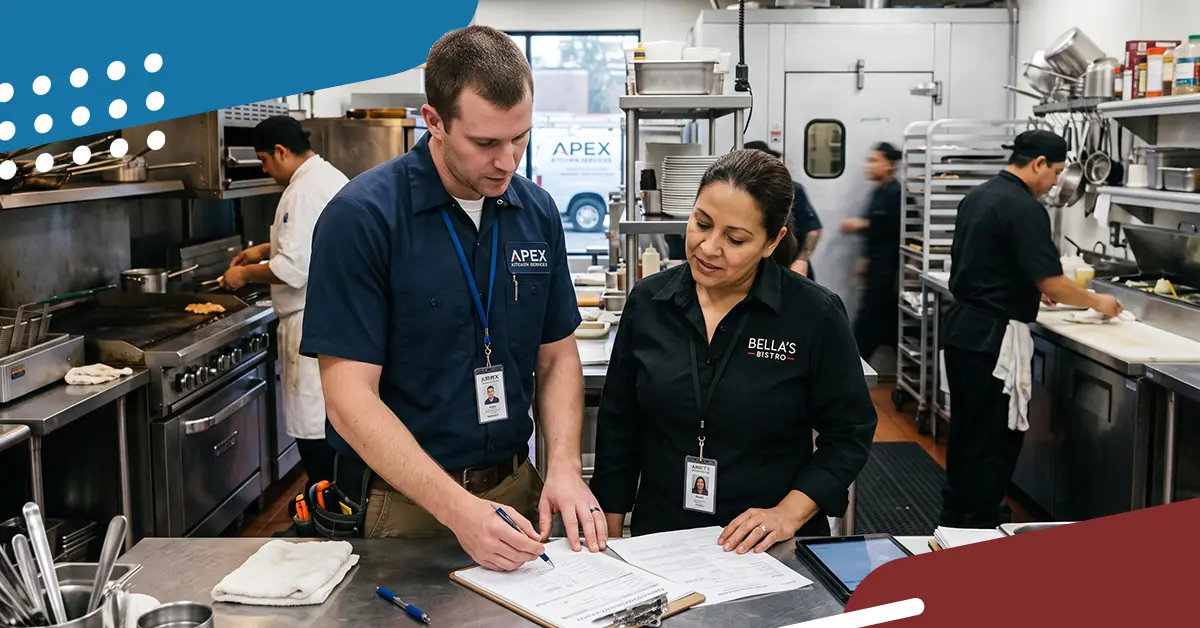
Reactive service demand can create uneven workloads, difficult dispatch planning, and seasonal revenue swings for commercial food-equipment service agencies. Well-structured back-of-house preventive maintenance agreements can produce more predictable recurring revenue while helping restaurant operators identify equipment problems earlier.
Successful agreements begin with a documented equipment inventory. From there, they clearly define the maintenance schedule, covered services, parts and labor, response commitments, exclusions, pricing, and reporting requirements. Standardized checklists and planned sourcing of compatible OEM and OCM parts can further improve service consistency and contract performance.
Why PM Agreements Benefit Service Agencies
For service techicians, responding to broken equipment calls is essential for business. But relying on emergency calls alone can create operational volatility. After all, demand may spike during extreme weather, holiday rushes, and peak operating periods before declining during shoulder seasons.
Preventive maintenance agreements help service agencies create a more balanced business model through three main advantages:
More Consistent Revenue: Monthly, quarterly, or annual billing creates a more predictable revenue stream to support technician labor, fleet expenses, and business overhead. Actual cash flow still depends on pricing, payment terms, and collections.

Better Fleet Planning: PM visits can be scheduled in advance during customer-approved service windows. Dispatch teams can group nearby locations, improve route density, and reduce unnecessary travel.

Proactive Repair Planning: Routine inspections can identify deteriorating components before they cause larger failures. Operators gain time to approve repairs and plan equipment outages, while service agencies gain better visibility into upcoming labor and parts demand.
What Every PM Agreement Should Define
Before pricing an agreement, complete a baseline audit of the customer’s equipment. Record the manufacturer, model, serial number, age, condition, service history, hours of operation, and manufacturer-recommended maintenance intervals. Document existing deficiencies and either correct them before coverage begins or exclude them from the agreement.
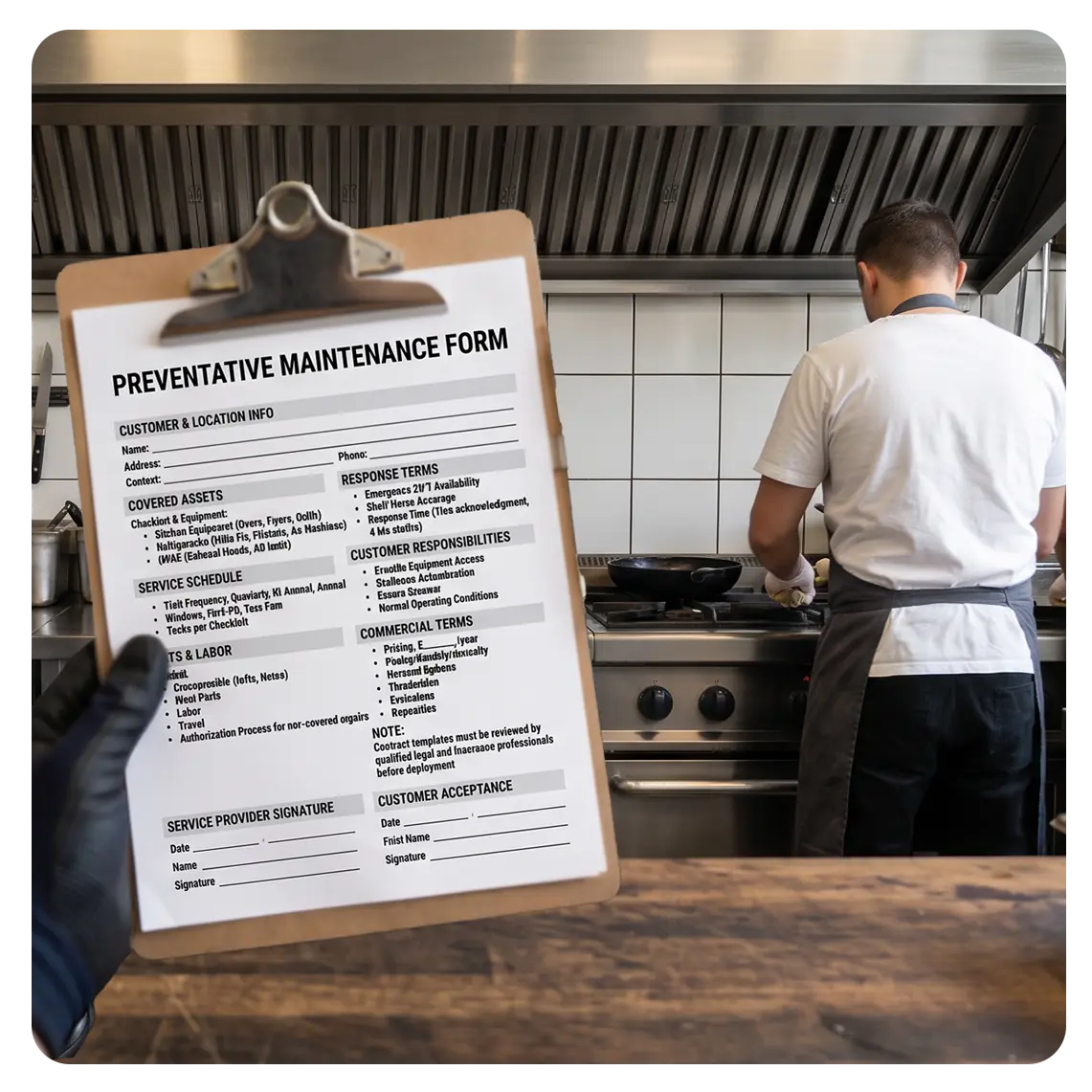
The final agreement must clearly define the following core terms:
Covered Assets: Locations and equipment included in the program.
Service Schedule: Visit frequency, approved service windows, and category-specific maintenance tasks.
Parts and Labor: Included consumables, wear parts, labor, travel, and materials, along with the authorization process for additional repairs.
Response Terms: Emergency-service availability, after-hours coverage, and the distinction between initial response acknowledgment and on-site arrival.
Customer Responsibilities: Equipment access, shutdown authorization, utility availability, and operating conditions required for service.
Commercial Terms: Pricing, billing, payment schedules, renewal options, termination clauses, exclusions, and warranty limitations.
Contract templates should always be reviewed by qualified legal and insurance professionals before deployment.
Three PM Service Tiers
Commercial kitchens vary in equipment count, operating volume, water conditions, and tolerance for downtime. A tiered framework allows service agencies to align maintenance coverage with each customer’s specific operational needs and budget.
| Service Tier | Typical Scope | Best Suited For |
|---|---|---|
| Essential Inspection & Cleaning | Visual inspections, operating checks, designated cleaning, equipment-condition reporting, and lubrication where required by the manufacturer. | Smaller operators and lower-volume kitchens seeking baseline equipment oversight. |
| Enhanced Preventive Maintenance | Essential coverage plus detailed performance testing, planned wear-part replacement, recommended-repair estimates, and preferred labor rates for work outside the agreement. | QSRs, hotels, casual dining, and other high-volume operations where downtime can significantly disrupt production. |
| Comprehensive Asset Support | Customized schedules, defined wear-part and labor coverage, asset reporting, annual budget planning, and priority response terms. | Institutions, universities, healthcare facilities, franchise groups, and multi-unit operators. |
Operational Note: Parts should be replaced according to equipment condition, test results, usage, manufacturer guidance, or documented service intervals—not simply because a PM visit is on the calendar. Priority-response commitments must reflect geography, technician capacity, and parts availability. Avoid promising an on-site response time the service network cannot consistently support.
Equipment-Specific PM Checklists
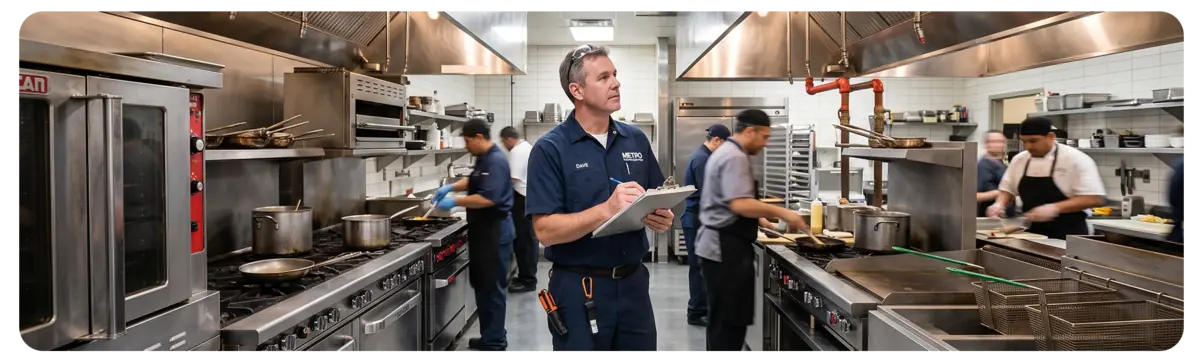
Standardized checklists help technicians provide consistent service and create comparable records across customers and locations. The following examples should be adapted to the manufacturer’s documentation and the defined scope of the agreement.
| Equipment Category | Key Inspection Points | Components to Inspect or Replace as Needed |
|---|---|---|
| Refrigeration | Condenser and evaporator condition, door alignment, drain clearance, airflow, operating temperatures, and defrost operation. | Gaskets, hinges, latches, fan components, and drain lines. |
| Cooking Equipment | Temperature performance, safety controls, door operation, electrical load, and combustion condition where applicable. | Contactors, relays, switches, thermopiles, probes, sensors, and door seals. |
| Ice & Beverage Equipment | Water pressure, scale accumulation, harvest-cycle performance, sump and bin condition, distribution system, and filter status. | Water filters, float switches, curtains, tubing, seals, and distribution components. |
| Warewashing | Wash and rinse performance, arm condition, final-rinse temperature, chemical delivery, door operation, and scrap removal. | Curtains, door gaskets, chemical tubing, wash-arm components, pump seals, and scrap trays. |
⚠️ Safety & Compliance Boundary
Preventive maintenance should be completed by qualified technicians following equipment-manufacturer procedures and applicable lockout/tagout (LOTO) requirements. Work that could open or otherwise compromise a refrigeration circuit must be performed by a technician holding the appropriate EPA Section 608 certification. Gas-pressure testing, combustion adjustments, electrical measurements, chemical-system service, and safety-control testing also require appropriate training, qualifications, and instruments.
Pricing and Parts Planning
A baseline equipment audit is essential for accurate contract pricing. Calculate the expected annual cost of providing the defined scope, including:
- Burdened technician labor
- Travel and dispatch time
- Administrative and reporting overhead
- Scheduled consumables and anticipated wear parts
- Visit frequency and customer scheduling restrictions
- Emergency-response exposure
- Equipment age, condition, contingency for scope variation, and target gross margin
The total projected cost can then be converted into a per-visit, monthly, quarterly, or annual fee. The agreement should explicitly state when invoicing occurs and how work outside the included scope will be authorized and billed.
Parts coverage can be structured in several ways: consumables may be billed separately, selected wear items may be included up to an annual limit, or labor may be covered while parts remain billable. Major components, pre-existing failures, misuse, and environmental damage should be clearly listed in the exclusions.
Review the covered equipment before each service cycle to identify high-wear components. Preordering or stocking these items can reduce repeat visits and help technicians complete approved repairs during the scheduled service window.
When compatible OCM parts are available, service agencies can reduce acquisition costs while meeting the fit, function, and specifications required for the application. Through AllPoints, OCM parts cost approximately 15% less than OEM parts on average, helping agencies price agreements competitively while protecting contract margins. Compatibility should always be confirmed using the equipment model and serial number, published specifications, and authoritative cross-reference information.
Frequently Asked Questions
How should service agencies price PM agreements?
Service agencies should start with a baseline audit to calculate the complete cost of fulfilling the agreement—not just the technician’s time at the machine. This calculation must factor in travel time, administrative reporting, scheduled consumables, anticipated wear parts, emergency-response risk, and target gross margin. Pricing can then be structured as a monthly, quarterly, annual, or per-visit fee.
How often should commercial kitchen PM visits occur?
There is no universal schedule. Visit frequency should reflect manufacturer guidance, equipment type, operating hours, environmental conditions, water quality, service history, and the operational consequences of failure.
Quarterly visits may provide a useful starting point for some equipment, while heavily used or operationally critical assets may require more frequent service. Ice-machine schedules should account for manufacturer guidance, water quality, usage, and environmental conditions. A single agreement can assign different schedules to different assets.
How do PM agreements support customer retention?
Regular visits help technicians understand the facility’s equipment, operating conditions, and repair history. Consistent documentation and proactive recommendations build trust with kitchen managers, positioning the service agency as the preferred first call for repairs, emergency service, and long-term equipment replacement planning.
Building a PM Program That Works for Both Sides
A successful preventive maintenance agreement creates shared value for both the service agency and the operator. The agency gains more predictable revenue, improved workload visibility, and streamlined parts planning. The operator gains documented equipment oversight, earlier detection of mechanical problems, and a clearer maintenance budget.
AllPoints supports service agencies with OEM and OCM replacement parts across commonly serviced commercial kitchen equipment. Use the AllPoints catalog and technical support resources to plan commonly used PM parts, evaluate replacement options, and keep scheduled service visits moving efficiently.